STEM Toys for Kids: What They Are, What Actually Works, and How to Choose (Ages 3–9)

Almost any toy can be sold as "STEM" today, and no official standard decides which ones earn the label. That's why two toys with the same badge can be completely different. One invites a child to test ideas for an hour. The other does one trick and gets put away.
This guide gives you a simple way to tell them apart. It explains what STEM play really looks like at ages 3 to 9, what early-learning researchers say matters most, and the kinds of toys that fit each stage. It also includes a balloon-car experiment you can try at the kitchen table.
What is a STEM toy?
STEM stands for science, technology, engineering and math. A STEM toy is one that gets a child doing those things: asking a question, trying something, watching what happens, and trying again.
For young children, that rarely looks like a classroom. It looks like:
- Science: looking closely, noticing differences, predicting, testing. "Will the leaf look different under the microscope?"
- Technology: using tools, and learning that machines follow instructions. "Why does the car follow my line?"
- Engineering: building, finding what fails, and making it stronger. "Why did my tower fall, and how do I stop it?"
- Math: counting, measuring, shapes, patterns and comparing. "Which ramp made the car go furthest?"
A toy covers "STEM" when it makes that kind of thinking likely, whatever the box says.
The one-minute test for any "STEM" toy
Before you buy, ask four questions:
- Can the child change something and see a different result? Changing a ramp's height, a balloon's size or a maze's layout is the heart of experimenting.
- Is there more than one way to play? Open-ended toys stay interesting much longer than toys with a single outcome.
- Does it give you something to talk about together? A good STEM toy naturally prompts "what if…?" questions.
- Will it still work when the novelty wears off? If the fun is mostly lights and sounds, interest usually fades fast.
A toy that passes three or four of these is likely to deliver real learning. A toy that passes one is probably just a gadget.
What research says actually helps
The toy matters less than what happens around it. In 2017, a group of researchers and educators from the Erikson Institute and the University of Chicago published Early STEM Matters, a policy report on STEM for young children. Among its guiding principles: adults need to help guide children's STEM experiences and support their natural curiosity, and discussion and visual representation such as drawing should be part of STEM learning. The report also argues that STEM education should start early, just as with language and literacy.
The American Academy of Pediatrics makes a similar point about toys in general. Its clinical report notes that electronic toys by themselves do not provide the interaction and parental engagement that matter most for healthy development.
In practice, that means:
- Talk while they play. Ask "what do you think will happen?" before they try, and "why do you think that happened?" afterwards.
- Let them draw it. A quick sketch of a tower design or a chart of results turns play into a real investigation.
- Don't fix it for them. A collapse or a car that won't move is the most useful moment in engineering play.
- You don't need to be an expert. "I don't know, let's find out" is a perfect STEM answer.
Building play has research of its own. We cover it in do puzzles and building blocks make kids better at math?
STEM toys by age
Ages 3–4: notice, sort, build, knock down
At this age, STEM means exploring with the senses and discovering cause and effect. Children are building their first mental models of how things work: things fall, magnets stick, shapes fit or don't.
Good choices: magnetic tiles and large blocks, shape and pattern games, simple ramps and ball runs, magnifiers, and sorting activities.
From our range: Magnetic Tiles let children build in 3D and see shapes combine. The Shape Matching Game builds early pattern recognition. Check the age grade and warnings on each product page, especially in homes with children under 3.
Questions to ask: "Which shape makes the strongest wall?" "How tall can we build before it falls?"
Ages 5–6: predict, test, measure
Now children can hold a prediction in mind and check it. Simple measuring comes in, along with fairer "tests" where you change one thing at a time.
Good choices: chain-reaction toys, track and maze builders, balloon- or spring-powered vehicles, pocket microscopes, and early counting tools.
From our range:
- The Car Balloon Toy shows thrust in action: air rushing backwards pushes the car forwards. It's a great first physics experiment (see the activity below).
- The Automatic Domino Train lays dominoes for you, so children can design chain reactions and see what makes them work or fail.
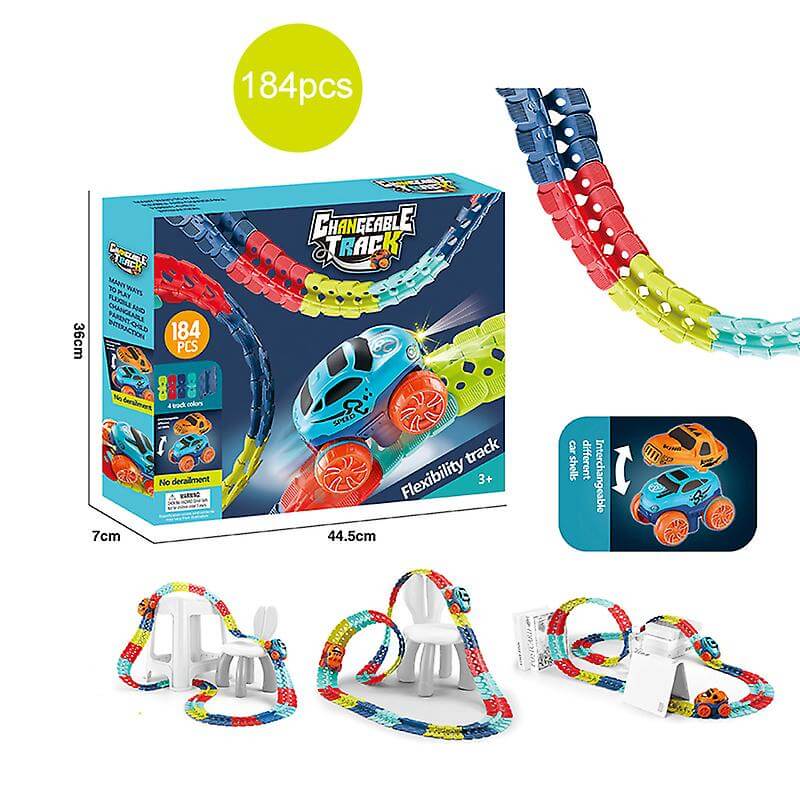
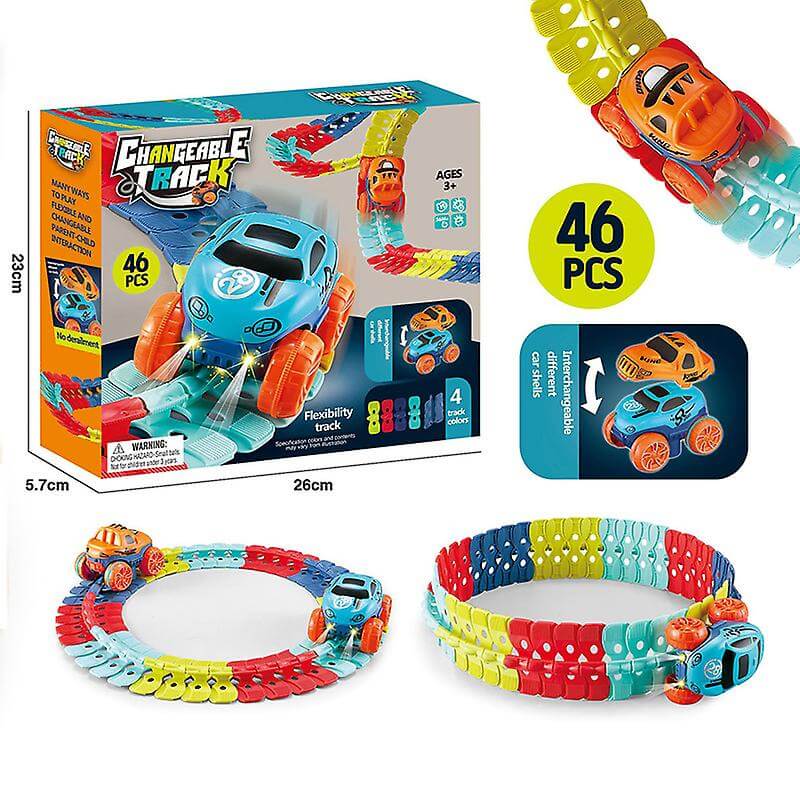
- The Smart Magnetic Rail Car Maze has 84 pieces to rebuild into new routes, which is engineering design in miniature.
Questions to ask: "If we use a bigger balloon, will the car go further?" "Which part of the track slows the train down?"
Ages 7–9: design, record, improve
Older children can plan, keep records and improve a design over several tries. They also start to enjoy "how does it work inside?" questions about technology.
Good choices: microscopes and observation kits, 3D design tools, more complex construction sets, logic puzzles, line-following or programmable toys, and math practice games.
From our range:
- The Kids Pocket Microscope is small enough to take on walks for looking at insects, plants and stones up close.
- The Magic Drawing Car follows lines your child draws on paper. It's an easy, screen-free way to talk about how sensors let machines "see".
- The Low Temperature 3D Printing Pen turns flat sketches into 3D models. Use it with adult supervision.
- The Rolling Math Stamp prints rows of sums for adding, subtracting, multiplying and dividing up to 100.
- The 3D Rolling Ball Maze Cube is a pocket-sized spatial-reasoning challenge.
Questions to ask: "Can you draw a track the car can't follow? Why does it fail?" "What's the smallest thing you can find that looks completely different under the microscope?"
Try it: the balloon-car distance experiment
This turns a single toy into a real investigation in about 20 minutes. It suits ages 5 and up, with an adult.
You need: a balloon-powered car, a tape measure or ruler, masking tape, paper and a pencil.
- Ask a question. "Does a bigger balloon make the car go further?"
- Predict. Your child writes or draws their guess.
- Set a fair test. Mark a start line with tape. Use the same floor surface every time.
- Test small, medium and large. Blow the balloon to three sizes (count breaths to keep it consistent), release, and measure where the car stops.
- Repeat. Run each size three times. Real scientists repeat tests, too.
- Record and compare. Draw a simple bar chart of the distances.
- Explain. Was the prediction right? What else might change the result, like carpet versus tiles?
That single activity covers science (testing), engineering (fair setup), math (measuring and charting) and technology (the car as a simple machine).
Safety note: the AAP warns that uninflated or broken balloons are a choking hazard for children under 8. An adult should inflate the balloons, supervise the activity, and throw away broken pieces right away (HealthyChildren.org).
Do kids need screens to learn technology?
No. For young children, "technology" is really about understanding that tools and machines follow rules. A car that follows a drawn line, a domino train that sets up a sequence, or a camera that captures light all teach that idea without an app. That fits AAP guidance favouring hands-on toys and shared play for young children. For screen-time limits by age, see our guide to how much screen time is OK for toddlers and preschoolers.
Common mistakes when buying STEM toys
- Buying too advanced. A kit that needs constant adult help can make a child feel "bad at science". It's better to start slightly easy and add challenge.
- Choosing one-trick gadgets. If the toy does the same thing every time, there's nothing left to discover.
- Ignoring the age label. Many science kits contain small parts, magnets, balloons or batteries. Follow the age grade, especially with younger siblings around. Our guide to age-appropriate toys explains what the labels mean.
- Leaving it in the box. The first session together sets the tone. Plan 15 minutes to explore it side by side.
Frequently asked questions
What counts as a STEM toy?
Any toy that gets a child questioning, testing, building or measuring. That includes building sets, ramps, magnifiers, chain-reaction toys and math games. The label on the box matters less than whether the toy invites experimenting.
Are STEM toys actually educational?
They can be, but the biggest factor is how they're used. Early-STEM researchers stress adult guidance and talking about what's happening. A simple toy used with good questions often teaches more than an expensive one used alone.
What age should kids start with STEM toys?
STEM play starts with infants dropping things to see what happens. Toys marketed as STEM usually begin around age 3, with open-ended building and sorting. Always follow each toy's age grade.
What is a good STEM toy for a 3-year-old?
Large building pieces, magnetic tiles labeled for that age, shape-sorting and pattern games, and simple ramps. Avoid kits with small parts or loose magnets if there are younger children in the home.
What is a good STEM toy for an 8-year-old?
Something they can design with and improve: a microscope, 3D drawing tools, logic puzzles, line-following toys, or construction sets with more pieces.
Do STEM toys need batteries or screens?
No. Many of the best STEM toys are completely unplugged. When a toy does use batteries, check that the compartment is secured with a screw.
The bottom line
A good STEM toy gives children something to wonder about and something to change. Pick toys that pass the one-minute test, match them to your child's age and interests, and spend the first few sessions playing alongside them. Most of the learning comes from the questions you ask together.
Explore science, building and discovery toys in our toys for 3–9+ years collection.